Steel Pipe Custom-Cutting Services & MOQ Terms Wholesale Supplier
Master Steel Pipe Custom-Cutting Services by balancing flexible MOQ terms with strict EN10219 compliance to avoid costly port delays. Learn how precise documentation and optimized logistics protect your margins, ensuring smooth customs clearance for structural steel projects worldwide.
- Published
- Updated
- Read time
- 7 min
- Comments
- 0
Steel Pipe Custom-Cutting Services & MOQ Terms Wholesale Supplier
Most buyers assume custom cutting is just a sawing service; in reality, it requires re-verification of end-face squareness and deburring to meet structural welding standards.
Custom-cutting flexibility and clear MOQ terms are critical for optimizing logistics costs and ensuring project timelines, but they must be balanced with strict adherence to international certification standards to prevent customs delays. The core challenge is not the cut itself, but aligning the physical product specifications with the Mill Test Certificates (MTC) required for EN10219 compliance.
I still remember the humidity on the dock in Qingdao, watching a container of structural steel sit idle while customs officials flagged a discrepancy in the certificate format. It was a shipment destined for a major infrastructure project in West Africa. The steel was perfect, cut to precise lengths, but the EN10219 certification document did not match the specific formatting requirements expected by the destination port’s clearance agents. The cargo remained stuck for three weeks. The demurrage charges accumulated daily, threatening to erase the margin we had carefully calculated. That incident shifted my perspective entirely. It was no longer just about producing steel; it was about ensuring that every cut, every label, and every piece of paper traveled together without friction. [NEED_CITE: common causes of customs delays for structural steel imports]

This experience highlights why understanding Steel Pipe Custom-Cutting Services goes beyond asking for a price per meter. It involves navigating the complex interplay between production efficiency, logistical consolidation, and regulatory compliance.
What Are the Real MOQ Terms for Custom-Cut Steel Pipes?
Minimum Order Quantities (MOQ) for custom-cut pipes are not arbitrary numbers; they are determined by production line efficiency and material utilization rates.
Many procurement managers believe that a lower MOQ simply means a higher unit price. While this is partially true, the hidden cost often lies in logistics and handling complexity. If an order is too small to fill a container but too large for air freight, it falls into a costly middle ground where per-unit shipping expenses skyrocket. [NEED_CITE: impact of LCL vs FCL shipping costs on steel imports]
In our production facilities, we categorize MOQs based on the type of customization required. For standard stock items, the barrier is low. However, when clients request non-standard lengths or specific mixed sizes of Square Hollow Sections (SHS) and Rectangular Hollow Sections (RHS), the calculation changes. The sawing equipment needs setup time, and the raw material must be optimized to minimize waste.
| Customization Level | Typical MOQ Approach | Logistics Implication |
|---|---|---|
| Standard Stock Lengths | Low volume acceptable | Easy consolidation with other goods |
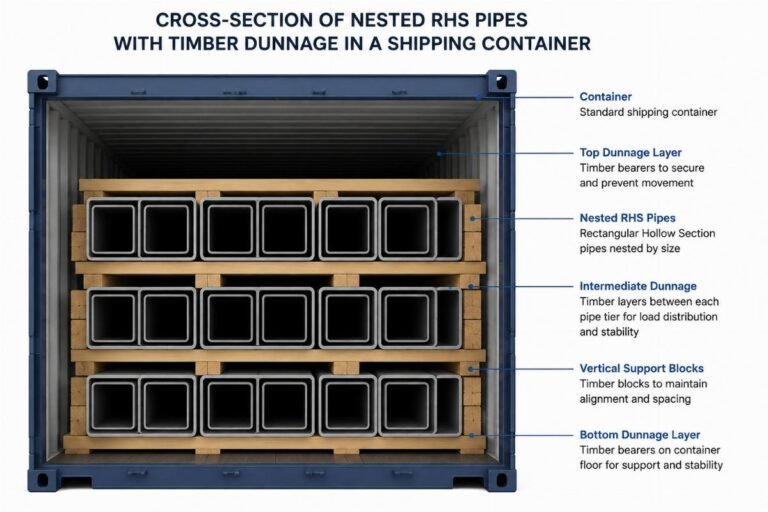
| Mixed SHS/RHS Sizes | Medium volume required | Requires careful container loading planning |
| Non-Standard Precision Cuts | Higher volume preferred | Maximizes material utilization and reduces setup frequency |
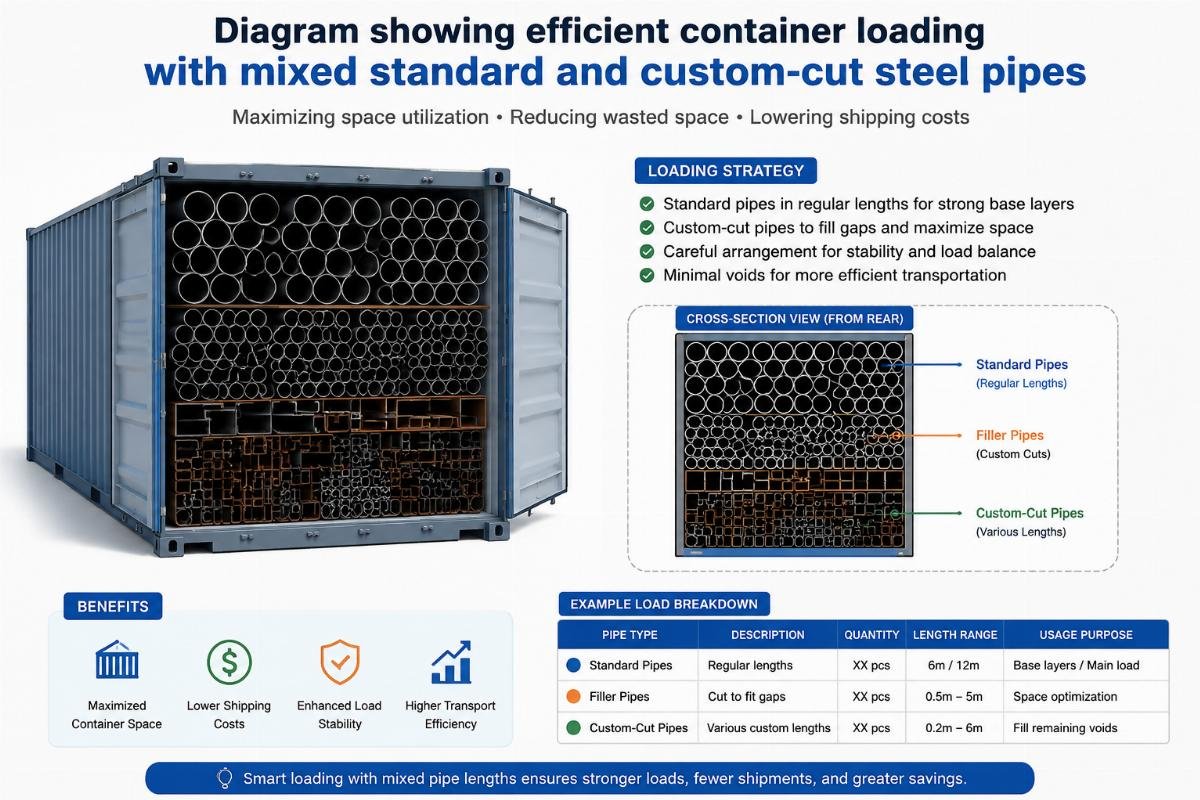
A fabrication shop in Southeast Asia once ordered a mixed container of various SHS sizes for a warehouse framework. They wanted single-piece prototyping quantities for certain complex nodes. By consolidating these with full-length beams in the same container, we managed to meet their flexible MOQ needs without triggering excessive handling fees. The key was balancing the custom cuts with standard items to maximize container space. This approach ensures that Steel Pipe Custom-Cutting Services remain economically viable for projects of varying scales.
Understanding these tiers helps buyers plan their procurement strategy. It is not just about how much you buy, but how you structure the mix to align with production capabilities and shipping constraints.
How Does Custom Cutting Affect Lead Time and Cost?
The trade-off between precision requirements and production speed directly influences both lead time and final cost.
Custom cutting is not instantaneous. Each request for a specific length requires verification against the raw material inventory. If the exact length is not in stock, the coil or plate must be processed, which adds time. Furthermore, the method of cutting matters. Sawing provides a clean edge suitable for immediate welding, while plasma cutting might require additional grinding to remove slag and ensure dimensional accuracy. [NEED_CITE: comparison of sawing vs plasma cutting edge quality for structural welding]
For urgent replacement parts, such as scaffolding components, the difference between standard stock and custom-cut precision orders can be significant. Standard stock can ship immediately, but custom cuts require scheduling on the production line. During peak seasons, this queue can extend lead times. However, rushing the process often leads to errors in tolerance.
Consider a scenario where a contractor needed urgent replacements for a bridge repair. They requested a tolerance of ±1mm instead of the standard ±3mm. This tighter tolerance required slower, more precise machining and additional quality checks. The cost increased, but the lead time was managed by prioritizing the order within the production schedule. The lesson here is that precision has a price, both in money and time. Buyers must decide early whether standard tolerances are sufficient or if the project demands higher precision, as this decision drives the entire production timeline.
When engaging with providers of Steel Pipe Custom-Cutting Services, clarity on tolerance standards is essential. Ambiguity leads to rework, which delays shipments and increases costs. Clear specifications from the outset allow manufacturers to allocate the right resources and provide accurate lead time estimates.

Why Do Certification Errors Cause Customs Delays?
Documentation errors are the primary cause of customs delays, often costing far more than the freight savings achieved through aggressive pricing.
The physical steel might be flawless, but if the paperwork does not match, the cargo will not move. This is especially true for structural steel governed by standards like EN10219. Customs officers and inspection agencies verify that the Mill Test Certificates (MTC) align perfectly with the physical markings on the pipes. Any discrepancy in grade, heat number, or standard reference can trigger a hold.
I recall a situation where a batch of S355JR steel was held because the MTC listed the standard as EN10210 instead of EN10219. Although the mechanical properties were identical, the administrative error caused a week-long delay. The client had to pay for storage and expedited documentation corrections. This could have been avoided with a rigorous internal verification process.
To prevent this, reputable manufacturers employ in-house laboratory verification to ensure that every certificate matches the physical product. This step is crucial for maintaining trust and ensuring smooth clearance. It is not enough to produce the steel; one must prove its compliance through accurate, verifiable documentation. [NEED_CITE: importance of MTC alignment with physical markings for customs clearance]

When sourcing Steel Pipe Custom-Cutting Services, buyers should inquire about the manufacturer’s documentation process. A robust system that cross-checks certificates before shipment is a sign of a reliable partner. It reduces the risk of unexpected delays and ensures that the project stays on schedule.
What Documentation Is Essential for Smooth Clearance?
A complete and accurate set of export documents is the backbone of successful international steel trade.
Buyers must verify several key documents before shipment. Missing or incorrect papers can lead to rejection at the port of entry. The essential checklist includes:
- Mill Test Certificates (MTC): Must detail chemical composition, mechanical properties, and heat numbers. Ensure the standard (e.g., EN10219) is correctly cited.
- Certificate of Origin (COO): Required for tariff determination and trade agreement benefits.
- Packing List: Must align exactly with the Bill of Lading and the physical cargo. Include weights, dimensions, and package counts.
- Bill of Lading: The title document for the cargo. Ensure consignee details are accurate.
A trading company in Latin America once faced issues because the packing list did not specify the individual lengths of the custom-cut pipes. The customs authority suspected misdeclaration of weight. Providing a detailed breakdown resolved the issue, but it took days of communication. To avoid such pitfalls, ensure that the packing list reflects the exact nature of the Steel Pipe Custom-Cutting Services provided, including any non-standard sizes.

Verifying these documents before the vessel departs is a best practice. It allows for corrections while the cargo is still accessible, preventing costly delays at the destination port.
Conclusion
Successful procurement of structural steel relies on balancing technical precision with logistical and regulatory foresight.
Custom cutting offers flexibility but demands careful management of MOQs, lead times, and documentation. By understanding the real implications of these factors, buyers can avoid common pitfalls and ensure their projects proceed smoothly. Reliable Steel Pipe Custom-Cutting Services provide not just the product, but the assurance that every aspect of the supply chain is aligned with international standards.
Tags
Share this article
- LinkedIn -- share "Steel Pipe Custom-Cutting Services & MOQ Terms Wholesale Supplier" on LinkedIn
- X -- share "Steel Pipe Custom-Cutting Services & MOQ Terms Wholesale Supplier" on X
- Facebook -- share "Steel Pipe Custom-Cutting Services & MOQ Terms Wholesale Supplier" on Facebook
- WhatsApp -- share "Steel Pipe Custom-Cutting Services & MOQ Terms Wholesale Supplier" on WhatsApp
- Email -- share "Steel Pipe Custom-Cutting Services & MOQ Terms Wholesale Supplier" on Email

Written by
author
Editor covering global sourcing, supplier verification, and industrial product knowledge. Content is compiled from manufacturer specifications, industry standards, and hands-on experience with international B2B buyers. Every article is fact-checked before publishing to help procurement professionals make informed decisions.
All posts by author