EN10219 Steel Pipe HS Code: Wholesale Supplier for Import
Avoid customs detention by using the correct EN10219 Steel Pipe HS Code for your imports. Cold-formed welded sections belong in the 7306 series, not 7304 for seamless tubes. Learn how to classify circular and rectangular shapes accurately to prevent duty discrepancies and logistical delays in strict markets.
- Published
- Updated
- Read time
- 9 min
- Comments
- 0

EN10219 Steel Pipe HS Code: Wholesale Supplier for Import
Most buyers assume all structural steel pipes fall under the same HS code category. This assumption is the primary cause of customs detention in the Middle East and Africa.
The correct HS code for EN10219 cold-formed welded structural hollow sections is typically within the 7306 series, specifically 7306.30 for circular sections or 7306.61 for square and rectangular sections. It is not 7304, which is reserved exclusively for seamless tubes. Misclassification leads to significant duty discrepancies and logistical delays.
Having managed procurement for large-scale infrastructure projects in Dubai before transitioning to manufacturing in Jinan, I have seen how a single digit in a tariff code can halt an entire shipment. The confusion often stems from a lack of clarity regarding the manufacturing process. EN10219 standards specify cold-formed welded pipes, yet many importers and even some freight forwarders default to the code for seamless pipes due to superficial similarities in application. [NEED_CITE: WCO HS Nomenclature explanation for heading 7304 vs 7306] This error triggers immediate scrutiny at ports like Jebel Ali or Durban, where customs officers are trained to identify high-value seamless tubes that might be misdeclared to avoid higher duties or specific anti-dumping measures.
Understanding the distinction is not just about compliance; it is about cost control and project timeline security. When you source EN10219 Steel Pipe HS Code compliant materials, the documentation must reflect the actual production method. The following sections break down why this classification matters, how to prove it, and what mistakes to avoid when importing into strict regulatory markets.
Why Do Customs Reject 7304 for EN10219 Tubes?
HS Code 7304 is strictly for seamless tubes, while EN10219 defines cold-formed welded products. Using 7304 for welded sections is a factual error that customs authorities treat as misdeclaration.
The Harmonized System (HS) categorizes iron and steel products based on their manufacturing method and physical characteristics. Heading 7304 covers “Tubes, pipes and hollow profiles, seamless, of iron (other than cast iron) or steel.” In contrast, heading 7306 covers “Other tubes, pipes and hollow profiles… welded, of iron or steel.” [NEED_CITE: General Rules for the Interpretation of the Harmonized System] EN10219 is a European standard that specifically applies to cold-formed welded structural hollow sections for general structural purposes. The key term here is “welded.”
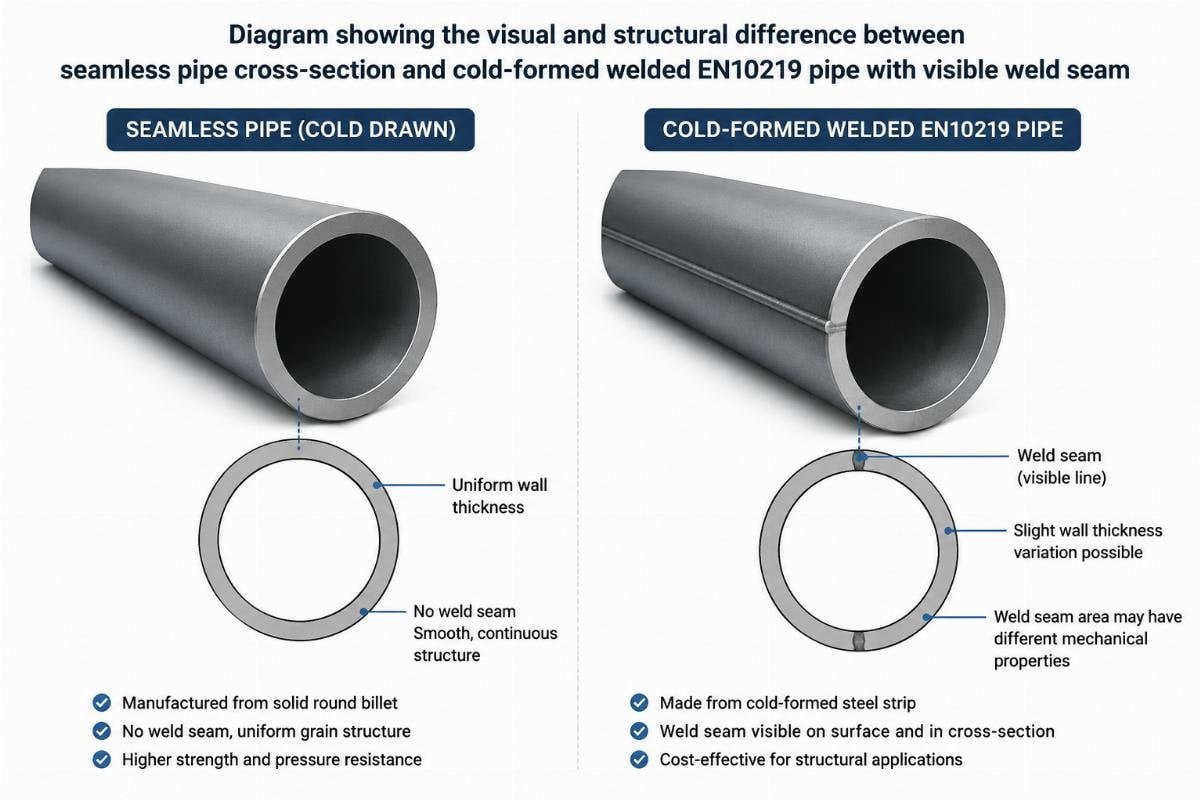
When a shipment of square or rectangular hollow sections (SHS/RHS) arrives with an HS code of 7304, customs inspectors look for the absence of a weld seam. Since EN10219 pipes are produced by rolling flat steel strips and welding them longitudinally, the weld seam is always present, even if it is dressed or hidden by surface treatment. Declaring these as seamless is technically incorrect.
In my experience handling exports from Shandong, I have seen buyers attempt to use 7304 because they believe it attracts a lower duty rate in their specific country. However, this strategy backfires. Customs labs in regions like the Gulf Cooperation Council (GCC) countries routinely perform microscopic analysis or ultrasonic testing on suspicious shipments. If the test reveals a weld line, the declaration is rejected. The consequences include re-classification to the correct code, payment of the duty difference, penalties for false declaration, and storage fees that accumulate daily. [NEED_CITE: Case studies of customs reclassification penalties in GCC countries]
Furthermore, the material grade specified in EN10219, such as S235JR or S355J2, does not change the HS code. The code is determined by the form (hollow section) and the method (welded), not the chemical composition. Therefore, regardless of whether you are importing mild steel or high-strength low-alloy steel, if it is cold-formed and welded, it belongs in 7306.

What is the Correct HS Code for EN10219 Steel Pipes?
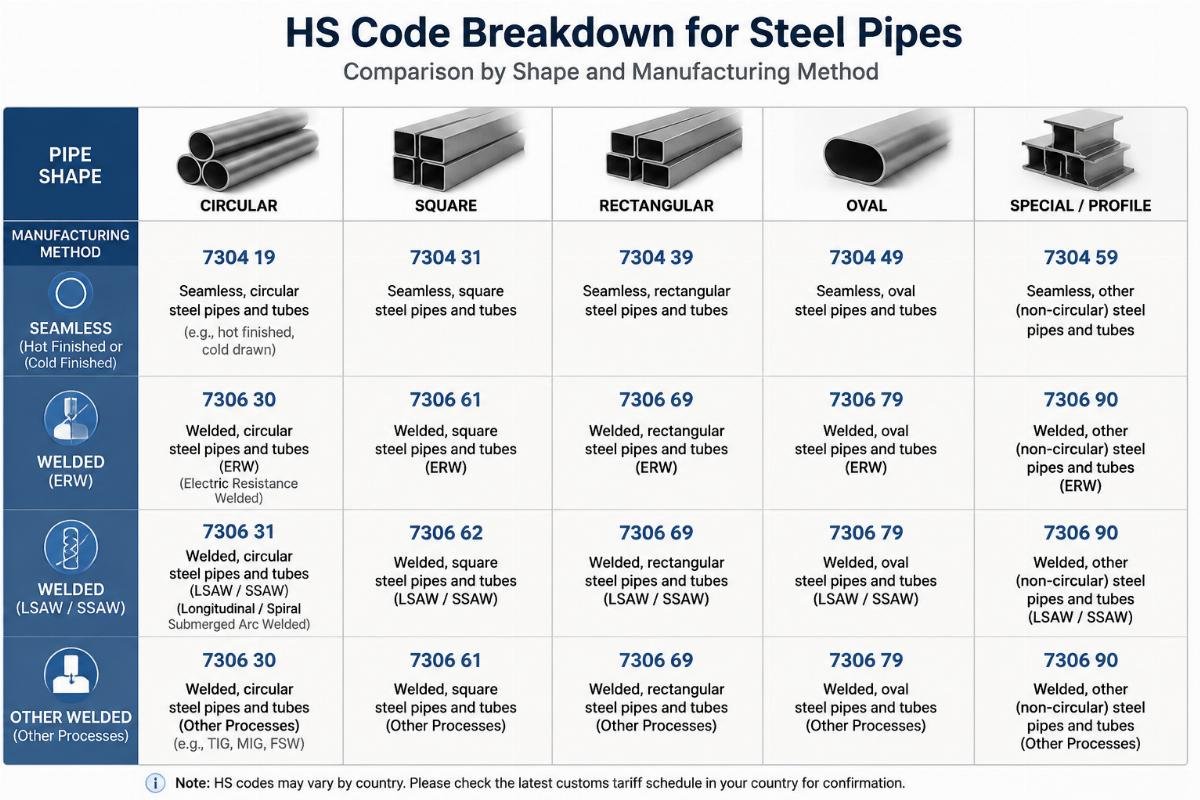
The precise HS code depends on the cross-sectional shape of the pipe. Circular sections generally fall under 7306.30, while square and rectangular sections fall under 7306.61.
While the heading 7306 is the correct category, the subheading varies by geometry. This distinction is critical for accurate duty calculation. Many importers make the mistake of using a generic “other welded tube” code without specifying the shape, which leads to queries from customs brokers who need precise classification for tax assessment.
For circular hollow sections (CHS) manufactured according to EN10219, the most common classification is 7306.30. This subheading covers “Other, welded, of circular cross-section, of iron or non-alloy steel.” If the pipe is made of alloy steel, it may fall under 7306.50, but EN10219 typically involves non-alloy or low-alloy structural steels.
For square hollow sections (SHS) and rectangular hollow sections (RHS), the correct code is usually 7306.61. This subheading is explicitly for “Other, welded, of square or rectangular cross-section, of iron or non-alloy steel.” Using the wrong subheading within the 7306 heading can still cause minor delays, as customs systems may flag inconsistencies between the described goods and the tariff line.
| Product Type | Standard | Manufacturing Process | Correct HS Heading | Typical Subheading |
|---|---|---|---|---|
| Circular Hollow Section | EN10219 | Cold-formed Welded | 7306 | 7306.30 |
| Square Hollow Section | EN10219 | Cold-formed Welded | 7306 | 7306.61 |
| Rectangular Hollow Section | EN10219 | Cold-formed Welded | 7306 | 7306.61 |
| Seamless Tube | ASTM A500/A501 | Seamless | 7304 | 7304.10/7304.29 |
[NEED_CITE: National Customs Tariff schedules for major import markets like UAE, Saudi Arabia, and Brazil]
It is important to note that some countries have additional national suffixes beyond the six-digit HS code. For example, an importer in Saudi Arabia might need an eight-digit code for statistical purposes. However, the first six digits remain consistent globally under the WCO framework. When preparing your commercial invoice and packing list, ensure that the description matches the HS code. A description stating “Seamless Steel Pipe” with an HS code of 7306 will trigger an automatic red flag. Conversely, “Cold Formed Welded Structural Hollow Section” with 7306 aligns perfectly.
Sourcing from a reliable EN10219 Steel Pipe HS Code aware supplier ensures that the initial documentation is correct. Manufacturers who understand these nuances will label the products and prepare the Mill Test Certificates (MTC) to reflect the welded nature of the product, supporting the declared HS code.
How to Prove “Cold-Formed Welded” Status to Customs?
Documentation must explicitly state the manufacturing process. A Mill Test Certificate (MTC) that references EN10219 and details the welding method is the primary evidence required for clearance.
Customs officers do not rely solely on the HS code provided by the importer. They require supporting documents that verify the nature of the goods. For EN10219 pipes, the MTC is the most critical document. It must be issued by the manufacturer and comply with EN10204 Type 3.1 or 3.2 requirements, depending on the contract.
The MTC should clearly indicate:
- Standard: EN10219-1 and EN10219-2.
- Process: Cold-forming and electric resistance welding (ERW) or high-frequency induction welding (HFIW).
- Dimensions: Outer diameter, wall thickness, and length.
- Mechanical Properties: Yield strength, tensile strength, and elongation, which confirm the structural grade (e.g., S355J2H).
In addition to the MTC, providing photos of the production process can be helpful in cases of dispute. Images showing the strip uncoiling, forming, and welding stages serve as visual proof that the product is not seamless. Some manufacturers also provide a certificate of origin that specifies the production method.
A common issue arises when the commercial invoice uses vague terms like “Steel Tubes” without specifying “Welded.” This ambiguity forces customs to inspect the cargo physically. To avoid this, the invoice description should be detailed: “Cold-formed Welded Square Hollow Sections, EN10219, S355J2H, HS Code 7306.61.”
During a recent shipment to a project in Southeast Asia, a mixed container load of SHS and seamless pipes was delayed because the documents did not separate the two types clearly. The customs broker had to manually segregate the items for inspection, causing a week-long delay. By ensuring that each item line on the invoice has its own correct HS code and clear description, such delays can be prevented. [NEED_CITE: Best practices for customs documentation in mixed steel shipments]
Suppliers who prioritize compliance, such as those with established export histories in Jinan, often include these details proactively. They understand that a clear paper trail reduces the risk of detention and builds trust with international buyers. When you verify the EN10219 Steel Pipe HS Code with your supplier, ask them to confirm that their MTC format supports this classification.

Common Classification Mistakes in Middle East & Africa Imports
Mixed shipments and vague descriptions are the leading causes of audits. Importers often fail to distinguish between welded and seamless items in consolidated containers.
The Middle East and African markets have stringent customs regulations due to the high value of steel imports and the prevalence of anti-dumping duties on certain steel products. In these regions, the margin for error is minimal.
One frequent mistake is consolidating different types of steel products into a single shipment without proper segregation in the documentation. For instance, a contractor might order EN10219 SHS for structural frames and seamless pipes for mechanical services. If both are listed under a single HS code or if the description is generic, customs will assume the highest duty rate applies to the entire shipment or detain the cargo for verification.
Another error is ignoring local regulatory updates. Countries like Egypt and Nigeria frequently update their import guidelines and required certifications. Failure to adhere to these updates, such as obtaining a pre-shipment inspection certificate from an approved agency, can result in rejection regardless of the HS code accuracy.
In Dubai, a case involving a batch of square tubes misdeclared under 7304 resulted in a three-day detention. The importer had to pay for re-inspection and amend the bill of entry. The cost exceeded the savings they hoped to achieve by using the wrong code. This highlights the importance of getting the classification right from the start. [NEED_CITE: Reports on customs clearance delays in Jebel Ali Free Zone]
To mitigate these risks, work with suppliers who have experience exporting to your target market. They will be familiar with the specific documentation requirements and can guide you on the correct EN10219 Steel Pipe HS Code usage. Additionally, engaging a local customs broker in the destination country before shipment can provide valuable insights into current enforcement trends.
Conclusion
Accurate HS classification is the foundation of smooth international steel trade.
Using the correct EN10219 Steel Pipe HS Code prevents costly delays and penalties. Remember that EN10219 pipes are welded, placing them in the 7306 series, not 7304. Ensure your Mill Test Certificates and commercial invoices clearly state the manufacturing process and cross-sectional shape. By prioritizing documentation accuracy and working with experienced suppliers, you can secure your supply chain and avoid the pitfalls of customs misclassification.
Tags
Share this article
- LinkedIn -- share "EN10219 Steel Pipe HS Code: Wholesale Supplier for Import" on LinkedIn
- X -- share "EN10219 Steel Pipe HS Code: Wholesale Supplier for Import" on X
- Facebook -- share "EN10219 Steel Pipe HS Code: Wholesale Supplier for Import" on Facebook
- WhatsApp -- share "EN10219 Steel Pipe HS Code: Wholesale Supplier for Import" on WhatsApp
- Email -- share "EN10219 Steel Pipe HS Code: Wholesale Supplier for Import" on Email

Written by
author
Editor covering global sourcing, supplier verification, and industrial product knowledge. Content is compiled from manufacturer specifications, industry standards, and hands-on experience with international B2B buyers. Every article is fact-checked before publishing to help procurement professionals make informed decisions.
All posts by author